Dubai Gold Line Metro and Property Investment 2026: What JVC, MBR City, and Meydan Investors Need to Know
Key Investment Takeaways
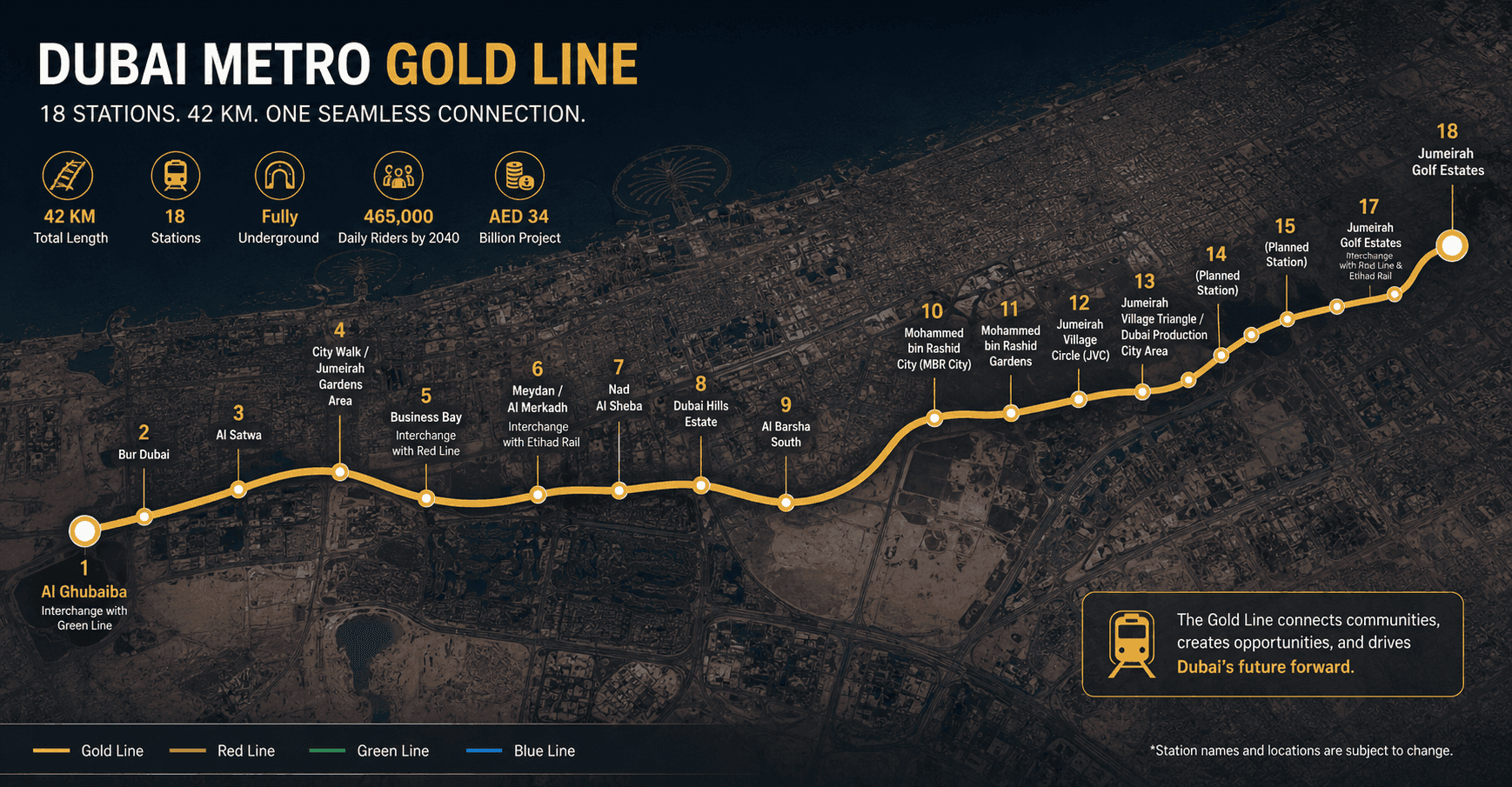
The Dubai Gold Line is a 42km fully underground metro line announced in April 2026, connecting 18 stations from Al Ghubaiba in Bur Dubai to Jumeirah Golf Estates via JVC, MBR City, Meydan, and Business Bay.
Communities gaining metro access for the first time, including JVC, MBR City, Meydan, and Al Barsha South, are forecast to see property value increases of 15% to 20% near stations. Construction runs from 2026 to 2032. The earlier you position in these communities, the more of the infrastructure premium you capture before the market prices it in fully.
The Dubai Gold Line is not just a transport project. It is the most significant infrastructure-driven property investment catalyst Dubai has seen since the original Red Line opened in 2009. Officially unveiled by His Highness Sheikh Mohammed bin Rashid Al Maktoum on 22 April 2026, the AED 34 billion line will run 42km entirely underground, connecting 18 stations across communities that have until now operated without mass transit connectivity. For property investors, the message from every previous Dubai metro expansion is the same: get in before the line opens, not after.
👉 Want to beat the market? Click here to chat with us on WhatsApp to get a curated list of secondary market and off-plan properties near the upcoming Gold Line stations before prices climb any further
What Is the Dubai Gold Line and Why Does It Matter for Property Investors?
The Dubai Gold Line is a 42km fully underground metro route operated by the Roads and Transport Authority (RTA), connecting Al Ghubaiba in historic Bur Dubai to Jumeirah Golf Estates in New Dubai. It is the first entirely underground metro line in Dubai, running at a depth of 40 metres beneath the city.
The line is designed to function as a central urban connector, integrating older established districts with high-growth residential corridors that are still in their early development phases. This is what makes it strategically different from previous Dubai metro expansions. The Gold Line does not simply serve communities that already have demand. It creates demand in communities that have been undervalued precisely because they lacked transit connectivity.
The Gold Line will serve an estimated 465,000 daily riders by 2040 and is projected to deliver a 430% cumulative economic return over 20 years of operation. For context, the AED 34 billion construction cost represents one of the largest single infrastructure investments in UAE history.
What Are the 18 Gold Line Stations and Which Communities Do They Serve?
The confirmed and planned Gold Line stations run through the following communities from east to west:
- Al Ghubaiba (interchange with Green Line)
- Bur Dubai
- Al Satwa
- City Walk / Jumeirah Gardens area
- Business Bay (interchange with Red Line)
- Meydan / Al Merkadh (interchange with Etihad Rail)
- Nad Al Sheba
- Dubai Hills Estate
- Al Barsha South
- Mohammed bin Rashid City (MBR City)
- Mohammed bin Rashid Gardens
- Jumeirah Village Circle (JVC)
- Jumeirah Village Triangle / Dubai Production City area
- Jumeirah Golf Estates (interchange with Red Line and Etihad Rail)
Four additional stations between Al Barsha South and JVC are planned, with official names expected in 2027, bringing the total to 18 confirmed stations. The loop design creates cross-town connections without requiring passengers to route through the central BurJuman interchange, making it significantly more efficient for residents in the communities it serves.
Which Communities Will See the Biggest Property Price Increase from the Gold Line?
The communities with the highest property value upside from the Gold Line are those gaining mass transit access for the first time. Based on current analyst forecasts and historical Dubai metro data, these are the three communities to watch most closely.
Jumeirah Village Circle (JVC): Dubai's Highest-Volume Market Gets Its Missing Piece
JVC has been Dubai's most active residential market by transaction volume for three consecutive years. The one factor consistently cited as a constraint on its premium potential has been the absence of metro connectivity. The Gold Line resolves this entirely. With a JVC station now confirmed, the community transitions from a high-yield, car-dependent investment to a high-yield, fully connected urban residential address.
- Current gross rental yields: 6.78% to 7.87% depending on unit type
- Entry prices: studios from AED 450,000, 1-beds from AED 650,000
- Forecast property value increase from Gold Line proximity: 15% to 20%
- Metro access timeline: Gold Line completion targeted for 2032
MARKET REALITY
Note: While off-plan projects in JVC will market the metro connection for years, the immediate price appreciation is being seen in ready-to-move assets where the infrastructure impact is now verifiable on the ground. Investors seeking to capture the near-term premium should focus on secondary market ready stock rather than waiting for off-plan delivery timelines that extend beyond the Gold Line's own completion date.
Meydan: The Strongest Multi-Modal Hub on the Entire Gold Line
Meydan is the single most strategically positioned community on the Gold Line. It receives not only a Gold Line metro station but also an Etihad Rail interchange, providing future connectivity to Abu Dhabi, Al Ain, and Sharjah by high-speed rail. No other community on the Gold Line has this multi-modal stack.
- Meydan sits 10 minutes south of Downtown Dubai by car, with direct access to Sheikh Zayed Road and Al Khail Road
- Binghatti's flagship Mercedes-Benz City development of over 13,000 units is located in Meydan, anchoring long-term demand
- Etihad Rail connectivity at Meydan means residents can commute to Abu Dhabi without a car by 2030
- Analyst consensus: Meydan has the highest capital appreciation potential of any Gold Line community for the 2026 to 2032 window
Meydan represents the textbook infrastructure investment play. It is a premium-positioned community transitioning from a low-liquidity premium market to a high-demand connected urban hub. The window for pre-completion entry is the next 12 to 24 months.
👉 Get the Yield Analysis: Don't wait for the market to price this infrastructure in fully. Click here and Message our team on WhatsApp now for a direct, community-by-community breakdown of the best available high-yield inventory in JVC and Meydan
Mohammed bin Rashid City (MBR City): Scale and Connectivity Combined
MBR City is one of Dubai's largest master-planned communities, encompassing residential, retail, and leisure developments across a vast footprint south of Downtown Dubai. The Gold Line delivers the transit link that transforms MBR City from a premium but isolated address to a fully integrated urban district.
- Mohammed bin Rashid Gardens, one of MBR City's most significant residential components, receives its own Gold Line station
- Forecast rental rate increase across Gold Line station communities: 15% to 30% based on RTA projections
- MBR City's proximity to Downtown Dubai means the Gold Line gives it effective Downtown connectivity without Downtown pricing
- Strong pipeline of under-construction residential projects means early investors can still access pre-completion pricing before the metro opens
What About Business Bay? How Does the Gold Line Change the Investment Case?
Business Bay already benefits from Red Line metro access at the existing Business Bay station. The Gold Line adds a second interchange point, which does not merely improve convenience. It provides investors with something far more valuable: liquidity protection.
When a community is served by two independent metro lines, it becomes insulated from the disruption risk of a single line's maintenance shutdowns, capacity constraints, or route changes. For buy-to-let investors and resale sellers, dual-line access means a larger pool of potential tenants and buyers who can reach the property by public transport from multiple directions. In practical terms, this compresses vacancy periods and supports resale exit timelines in ways that single-line connectivity cannot.
- Business Bay average resale price: AED 1,450 to 2,360 per sqft (DLD 2026 data)
- Business Bay gross rental yield: 7% to 9% for well-positioned ready stock
- Gold Line interchange effect: dual-line connectivity protects liquidity across both tenant and buyer cycles
- Business Bay remains one of the strongest resale exit markets in Dubai regardless of broader supply conditions
What Does the Historical Data Say About Metro Access and Dubai Property Values?
Dubai has a clear and consistent data track record on what happens to property values when metro access arrives, documented across every phase of Dubai Land Department transaction records since the Red Line opened in 2009.
- Properties within 500 metres of a Dubai metro station have historically appreciated 15% to 25% above community average in the 3 years following station opening
- Rental premiums near metro stations have consistently run 10% to 15% above non-metro-connected units in the same community
- Vacancy rates near metro stations are consistently lower, reducing the risk of income gaps between tenancies
- The current Gold Line forecast of 15% to 20% property value increases near stations is conservative relative to what the Red Line delivered for communities like DIFC and Dubai Marina
The most important data point for investors is timing. Historical analysis of Dubai metro expansion shows that the majority of the infrastructure premium is priced in during construction, not after opening. Investors who entered JBR and Dubai Marina during Red Line construction captured the full appreciation cycle. Those who entered after opening captured only the residual growth.
👉 History repeats itself in Dubai. Position your investment portfolio before the 2026–2029 high-leverage entry window closes, Click here to consult with a Gold Line Specialist on WhatsApp to view verified historical tracking data.
How Does the Gold Line Connect to the Wider Dubai 2040 Vision?
The Dubai Gold Line is a core infrastructure pillar of the Dubai 2040 Urban Master Plan, which targets a population of 5.8 million residents and positions Dubai as a leading global city for sustainable urban living. The Gold Line's role within this plan is to redistribute growth from the congested central core toward the high-growth southern and western corridors.
- Once Etihad Rail passenger service launches, Gold Line stations at Meydan and Jumeirah Golf Estates will provide direct connections to Abu Dhabi, Al Ain, and Sharjah
- The Gold Line's integration with the existing Red and Green Lines creates a fully networked metro system serving all major employment, retail, and leisure destinations in Dubai
- Dubai's overall metro ridership is projected to grow to over 465,000 daily Gold Line riders alone by 2040
- The Gold Line is the first Dubai metro line designed specifically to serve communities still in development, meaning it builds demand rather than serving existing demand
For property investors, aligning with a government-mandated infrastructure corridor is one of the lowest-risk strategies available in any market. The Dubai government has a 20-year track record of delivering on infrastructure commitments and following through with investment that sustains demand in the communities its infrastructure serves.
What Should Investors Do Right Now to Position for the Gold Line?
The Gold Line was announced in April 2026. Construction runs through to 2032. That is a 6-year window in which the infrastructure premium is expected to accumulate. Here is the strategic framework:
- Enter before 2028 for maximum upside: the first two years of a major infrastructure announcement typically see the sharpest price acceleration. JVC and MBR City are already registering increased inquiry volumes from this effect
- Prioritise communities gaining metro access for the first time: JVC, MBR City, Meydan, and Al Barsha South have the highest upside because they are transitioning from no-metro to fully-connected status
- Focus on ready-to-move stock in JVC first: as the Market Reality note above confirms, immediate price appreciation is being seen in secondary market ready assets where the infrastructure impact is already verifiable. Off-plan timelines in JVC often extend beyond 2032
- Use Business Bay as a liquidity anchor: dual-line interchange access makes Business Bay the most liquid exit market in the Gold Line corridor. Investors who want infrastructure exposure with the strongest resale protection should weigh Business Bay heavily in their portfolio allocation
- Consider rental yield while capital gains accrue: JVC already delivers gross yields of 7% to 7.87%. The yield runs from day one while the infrastructure premium builds in the background
Seven Century Real Estate holds active listings across all key Gold Line communities including JVC, MBR City, Business Bay, and Meydan. 👉 Message us on WhatsApp to speak with a Gold Line investment specialist today.
Does the Dubai Gold Line Make These Communities Eligible for a UAE Golden Visa?
The UAE 10-Year Golden Visa requires a minimum property investment of AED 2 million. Most Gold Line community entry points in JVC and MBR City fall below this threshold at the studio and 1-bedroom level. However, 2-bedroom and larger units in JVC, most MBR City inventory, and Meydan premium units comfortably reach or exceed the AED 2 million threshold.
- JVC 2-bedroom units: from AED 1.2 million to AED 2.5 million depending on building and floor
- MBR City 1 and 2-bedroom units: from AED 1.8 million to AED 4 million
- Meydan premium 1 and 2-bedroom units: from AED 1.5 million to AED 3.5 million
A portfolio approach, combining two Gold Line community units whose combined value meets the AED 2 million threshold, is a viable and increasingly popular strategy that delivers both Golden Visa eligibility and portfolio diversification. Our UAE Golden Visa property guide covers the full eligibility requirements and structuring options in detail.